

Complexity Kills Progress

Everyone says we need to move faster. Build faster. Field faster.
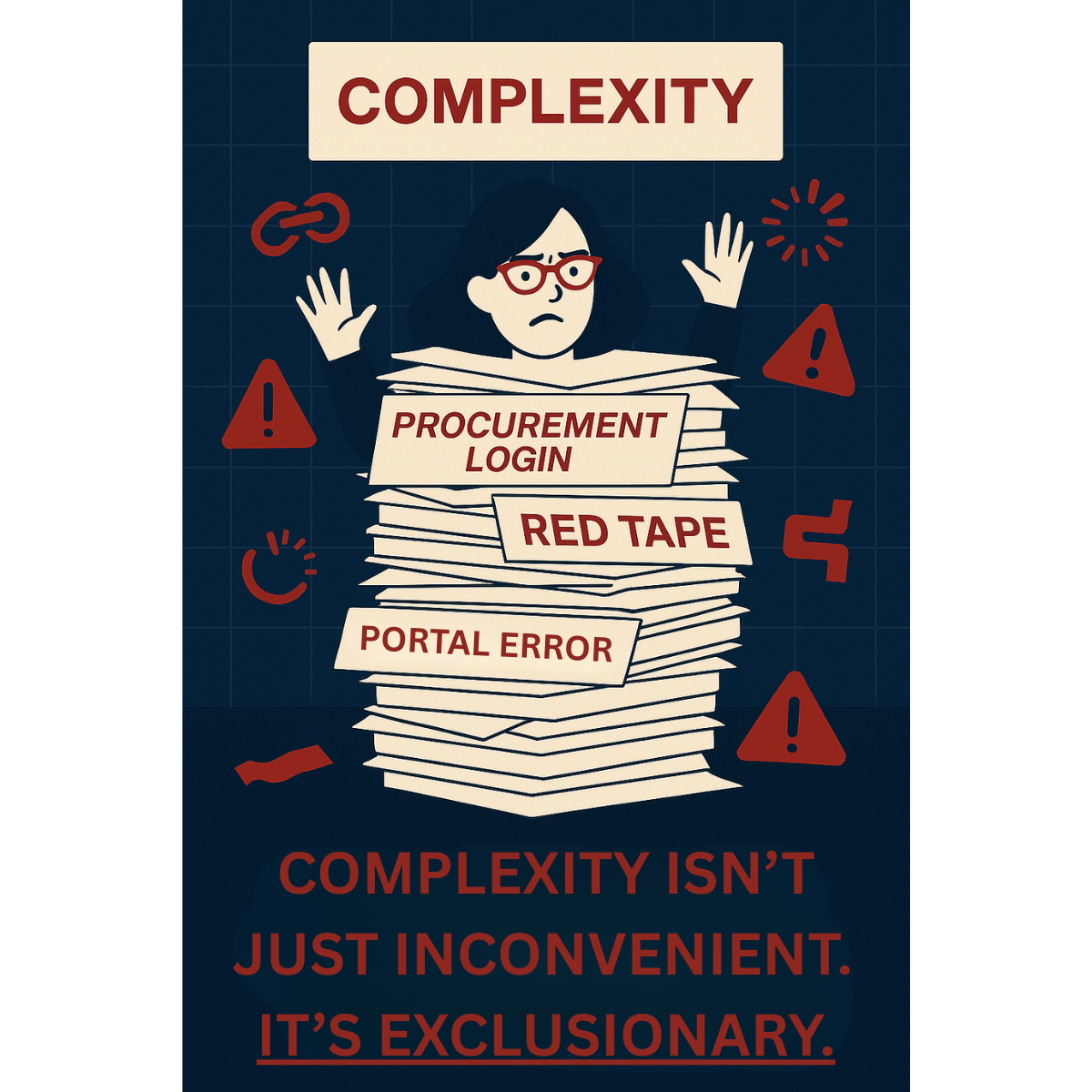
But no one admits the truth: the complexity in our own systems is what slows us down.
The Reality
For small businesses, the defense world is sold as a place where innovation thrives. “We need you,” the pitch goes. “You’re agile, you’re fast, you take risks the big players can’t.”
But when you actually try to participate, the obstacles aren’t technical. They’re procedural.
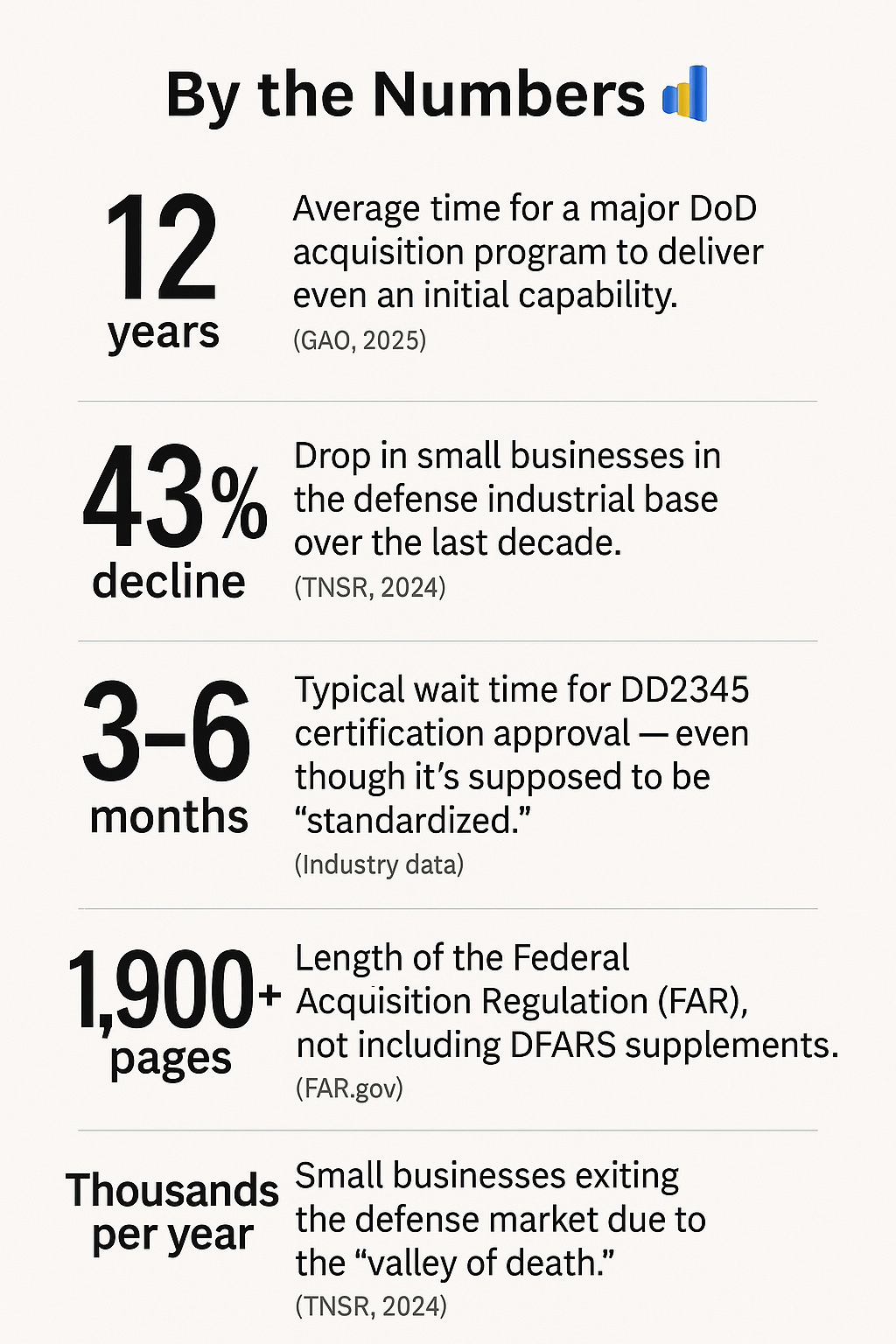
Take UTIC. It’s pitched as a gateway into defense, a consortium that lowers barriers. In practice, it can take months just to clear DD2345 certification — a relic of Cold War paperwork. If your entity name or address is off by a character, it gets bounced. Each fix costs weeks.
Then there’s SPRS. This portal is supposed to be the place to submit your NIST 800-171 score. Except when we tried, it repeatedly failed to load, wouldn’t save inputs, and crashed mid-submission. Tickets went unanswered for weeks. During that time, we were effectively locked out of opportunities.
Inside our shop, the reality was stark: carbon fiber sat untouched, molds stayed idle, and engineering time was diverted away from building into bureaucratic firefighting.
This isn’t isolated. It’s systemic.
The Problem
The defense acquisition system has become so layered and rigid that it’s nearly impossible to know which rules apply — let alone comply with them.
Administrative Isolation
The Defense Business Board puts it bluntly:
“The Department’s acquisition system is fragmented, slow, and risk-averse, with overlapping authorities and unclear points of entry that deter non-traditional partners.”
(Defense Business Board, Industry Partnerships for Crises, Nov 2022)
This isn’t just about forms. It’s a culture of complexity that keeps new entrants at arm’s length.
The “Valley of Death”
Attrition is staggering:
“The valley of death causes thousands of companies to leave the defense market annually and has resulted in a 43 percent decline in small businesses in the defense industrial base over the last decade.”
(Texas National Security Review, Jan 2024)
It’s not that small companies don’t want to be here. It’s that they can’t afford to survive the maze of portals, flow-downs, and moving goalposts.
Regulatory Overload
The Federal Acquisition Regulation (FAR) was meant to standardize procurement. Instead, it’s become an obstacle course.
“The complexity of complying with the FAR discourages competition, especially by small companies, and … ‘our contracting officers in the trenches can’t even follow them all because they actually start to conflict with each other.’”
(FAR overview, via Wikipedia)
If even contracting officers can’t interpret the rules consistently, what chance does a five-person shop have? For us, compliance isn’t just a line item — it’s a second full-time job.
The Ultimate Irony
These systems were built in the name of accountability and security. On paper, that sounds unimpeachable.
But here’s the paradox: in practice, the very systems meant to ensure accountability have become a catastrophic anti-innovation filter.
Accountability becomes ritual: Success is measured in forms submitted and checkboxes filled — not in capabilities delivered.
Security becomes circular: Portals meant to prove compliance are so brittle they undermine trust in the very data they collect.
Innovation gets suffocated: The more time small teams spend proving their existence, the less time they spend building.
And the consequences show up everywhere:
GAO found that “the expected time frame for major defense acquisition programs to provide warfighters with even an initial capability is now almost 12 years from program start. These time frames are incompatible with meeting emerging threats.”
(GAO, June 2025)A 2024 watchdog report summarized the impact even more bluntly: the U.S. military is “alarmingly slow” at delivering new weapon systems, eroding its competitive edge against top threats.
(Business Insider, June 2024)
This isn’t just inefficiency. It’s dangerous. While innovators are stuck in paperwork purgatory, threats in the real world aren’t waiting.
What Works (When It Works)
OTAs — Other Transaction Authorities — are the rare bright spot. Conceived as a workaround to outdated, rigid procurement, they offer agility to an otherwise glacial process.
Why OTAs Were Created
OTAs were designed to attract nontraditional contractors — startups, research institutions, small manufacturers — who would never survive the FAR maze. DARPA pioneered them in the 1990s; Congress expanded their use in 2016 to cover DoD-wide prototypes and R&D.
What OTAs Enable
Flexibility: Exemption from most FAR clauses, allowing commercial-style agreements.
Faster Development: As Booz Allen notes:
“OTAs enable faster prototyping and iteration by eliminating many of the process bottlenecks of FAR-based contracting.”
Prototype-to-Production: Successful prototypes can transition to production under the same OTA.
Access to Innovation: MITRE stresses:
“OTAs provide the government with access to innovations from nontraditional contractors that might not otherwise work with DoD.”
Improved Collaboration: RAND found OTAs bring “improved communication and reduced administrative burden.”
OTA Success Stories
Pivotal Software – In 2017, won an Air Force prototype OTA for cloud-based Air Operations Center software. From white paper to 12-month contract in three weeks. The system now saves the Air Force $1M/day in operating costs.
Technical Direction, Inc. – Used a $1.2M OTA from AFRL in 2018 to redesign missile engine production, cutting costs by $14,000 per unit.
Broader Impact
Defense Innovation Unit (DIU): Uses OTAs for rapid 90-day prototypes with dual-use startups.
System-wide growth: OTA usage expanded from $0.76B in FY2015 to $16.18B in FY2020.
Rhode Island’s OTA Corridor
This isn’t just a DC story. Rhode Island has its own OTA foothold:
NUWC Newport holds OTA authority to accelerate undersea innovation.
UTIC (Undersea Technology Innovation Consortium), headquartered in Middletown, manages a Navy OTA and awarded an $18.2M prototype contract in 2019.
The pathway is here — but it’s not frictionless. For many small shops, getting into UTIC or onto NUWC’s radar still feels like a closed loop.
If Rhode Island wants to live up to its branding as an ocean tech hub, it has to go further. Hosting the vehicles isn’t enough. We need clearer on-ramps, lower barriers, and active outreach so the shops doing real work can actually plug in. Otherwise, even with OTA authority in-state, we risk replicating the same exclusionary complexity OTAs were designed to solve.
The Argument
Complexity isn’t a side annoyance. It’s the enemy of speed, competitiveness, and trust.
The defense world says it wants agility and innovation from small businesses. But you can’t demand agility while burying suppliers under contradictory requirements, broken portals, and expired clauses. Every extra step bleeds away momentum. Every ambiguous rule adds cost. Every broken system drives another small company out of the sector.
And this isn’t just a small business complaint — it’s a national security issue. The threats we face don’t wait for portal resets or legal clarifications. Adversaries aren’t slowed down by redundant clauses; they’re iterating while we’re uploading forms. Complexity doesn’t just slow the system. It makes us less competitive on the world stage.
We’re not asking for lower standards. We’re asking for functional systems. Accountability should be measured in outcomes — secure, reliable technology delivered at speed — not in how many portals we logged into or how many outdated forms we filled out.
If the DoD is serious about rebuilding its industrial base, it needs to confront this complexity head-on:
Kill expired clauses: Stop passing down requirements that no longer exist.
Fix the portals before mandating their use: Don’t hold companies accountable for compliance systems that don’t function.
Scale OTA-style flexibility: Move OTAs from exception to default, so contracting speed is the norm, not a niche.
Measure what matters: Focus on outcomes — prototypes built, capabilities fielded, systems tested — not paperwork completed.
Because right now, the system is bleeding out the very companies it claims to need most. The gap between what leadership says it wants and what the system actually delivers is widening — and if we don’t close it, we risk losing both the innovators and the edge they bring.
In the end, complexity doesn’t protect progress — it strangles it.
Shop Talk
Last week, I asked: “Where have you seen complexity kill progress — in manufacturing, procurement, or beyond?”
The stories came back from every corner of industry:
Aerospace engineer: “We had a simple two-page engineering change that turned into a 60-page approval packet. The actual fix took an hour. The approvals delayed production for weeks.”
Small business owner in defense tech: “The hardest part of compliance isn’t the standards. It’s figuring out which portal is live today and which password still works.”
Startup founder partnering with a prime: “By the time the subcontract clears legal and compliance, the tech we pitched is already obsolete.”
Different industries, same problem: systems that were supposed to ensure accountability end up draining momentum and killing ideas before they can make impact.
And that ties straight into where we’re headed next. Dual-use founders are constantly told: “Go commercial first.” But what if the commercial market doesn’t exist yet — and the real need is on the defense side?
I’d love to hear from this community:
👉 What’s one big decision you made before your market fully existed — and how did it play out?
👀 Liked this post?
Subscribe for candid dispatches from the middle miles of dual-use tech, manufacturing, and defense.
Real tech. Real truths. Delivered straight to your inbox.